
6 Tile Trends That'll Make You Rethink Every Surface in Your Home
6 Tile Trends That'll Make You Rethink Every Surface in Your Home
.jpg)
2026 belongs to personality. The most interesting homes right now feel like the people who live in them. They're specific and layered, built around the colors and textures that feel most like home to one particular person. That kind of space asks a lot of its materials, because everything in it has to hold up to daily life without losing its character along the way.
Tile has turned out to be one of the most useful answers. It has always handled the hard work of a busy home: spills, foot traffic, heat, moisture, and the wear of people actually living there. What's changed this year is the design range behind it. Even the palette has shifted: terracotta, clay, and ochre have replaced the cool grays of the last decade. Six trends are shaping how tile looks in 2026, and choosing just four favorites from each one was the hard part.
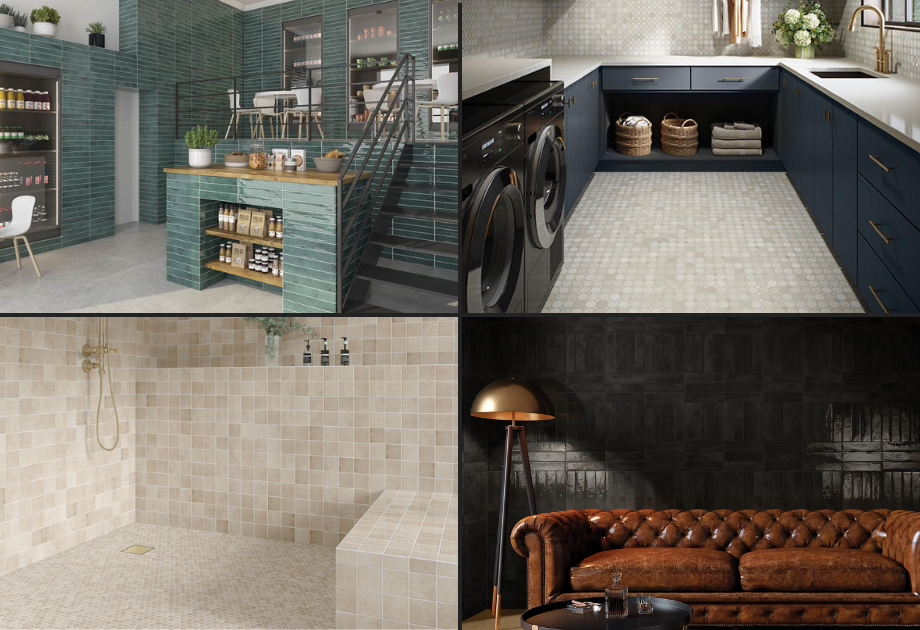
Zellige: Light, Texture, and a Glaze Like No Other
Zellige is a handmade Moroccan tile, and everything interesting about it comes from how it's made. Unrefined clay is shaped by hand, sun-dried, glazed, and kiln-fired, all without machinery. The result is a tile where no two squares come out identical, each one carrying small variations in color, texture, and glaze thickness.
That variation is what gives a Zellige installation its signature effect. Morning sun moving across a kitchen backsplash reveals a surface that shifts with the hour, the glaze catching light in some spots and breaking in others. What could be a flat wall seems to breathe instead, and you can tell, immediately, that a person made this.
The 2026 palette has leaned further into that handmade warmth. The raw clay body gives every glaze a depth that reads as warm on its own, so even the coolest colorways in a Zellige collection feel grounded. The Tile Council of North America named artisan aesthetic a defining direction for the year, and Zellige sits at the center of that call.
Pictured: Daltile Relicca, American Olean Studio Haven, Hamilton Parker Roca Zellige, and Louisville Tile Storied. Roca Zellige and Storied are rated for walls only; each product page lists full specs and approved applications.
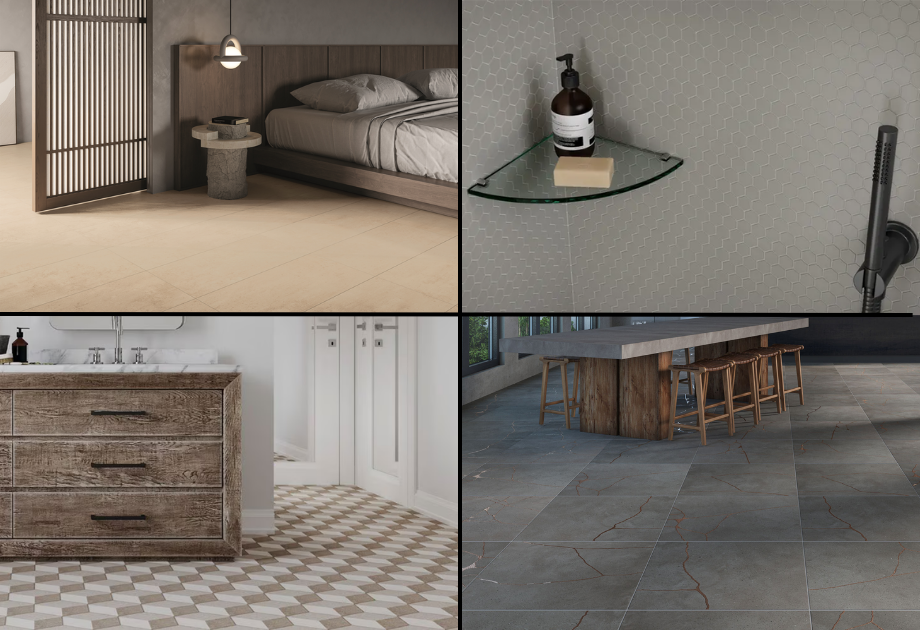
Artisan Cement Tile: Soft, Matte Floors That Anchor a Room
Cement tile is made by pressing pigment, cement, and marble dust into a mold under high pressure, then curing the result without firing. That cold-pressed construction gives the finished tile a soft, lightly chalky surface and a density that holds up beautifully under foot traffic. The effect reads closer to a pressed stone than a glazed ceramic.
What sets cement tile apart in a finished room is restraint. A floor in soft oatmeal, dove gray, or warm charcoal settles into the room the way a linen sofa does, giving wood vanities, metal fixtures, and natural textiles the space to come forward. The matte finish does half the work. It absorbs light instead of reflecting it, which keeps the floor feeling grounded even in rooms with a lot of glass or direct sun.
That quality is why cement tile has become a go-to for interiors that want presence without noise. The palette stays neutral, but the surface carries enough character that the floor never reads as a blank. A veined or lightly worked face can add just enough movement to make the tile feel thoughtfully designed, especially in bathrooms, bedrooms, and open living spaces where the floor is part of the room's overall calm.
Pictured: Hamilton Parker Vine Street Kilbourne Concrete, American Olean Crafter, Louisville Tile Pace, and Daltile Kintsugi. Each product page lists full specs and approved applications.
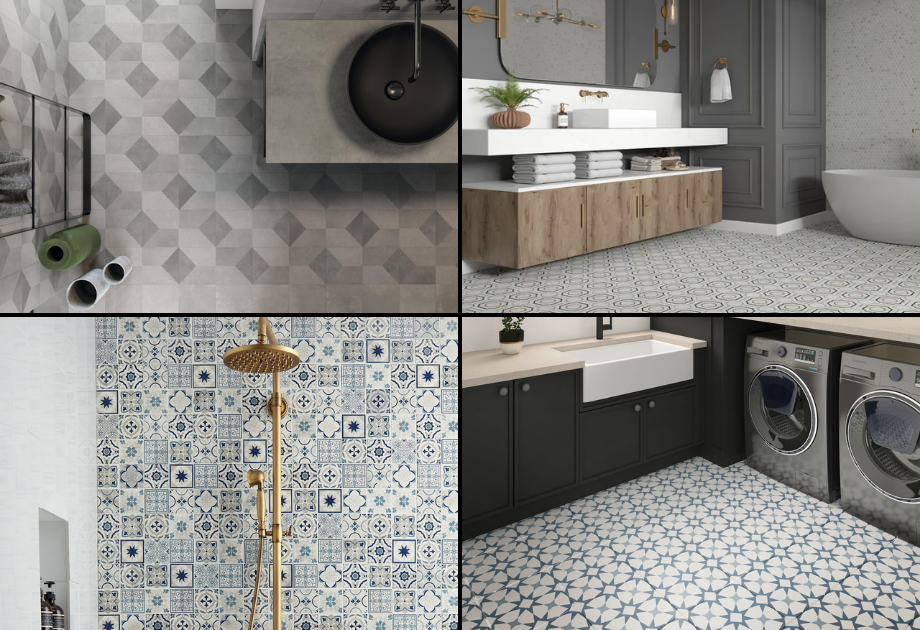
Encaustic Patterns: Design That Goes All the Way Through
Encaustic tile is a patterned tile made by pressing layers of colored cement into a mold, so the design sits inside the body of the tile rather than on its surface. The pattern isn't printed and isn't glazed, which means it can't scratch off or wear down. A decade of foot traffic through a busy kitchen leaves an encaustic floor looking the way it did on installation day.
What encaustic does in a finished room is announce personality at a glance. The patterns trace back to Moorish, North African, and Mediterranean tile traditions, and they carry that same bohemian, collected-over-time feeling into a modern home. An entryway laid in a blue Moroccan star pattern welcomes guests with warmth and real design confidence, while a kitchen floor in terracotta-and-cream florals feels like it belongs in a villa someone has actually lived in for years.
That expressiveness is the consideration. Encaustic works when the room gives it space to speak. Simpler cabinetry, plainer walls, and restrained fixtures let the pattern do what it's designed to do. A busy room with encaustic competes with itself. A restrained room with encaustic becomes unforgettable.
Pictured: Louisville Tile Clarity, Daltile Sublimity, Daltile Memoir, and Hamilton Parker Venti Boost. Each product page lists full specs and approved applications.
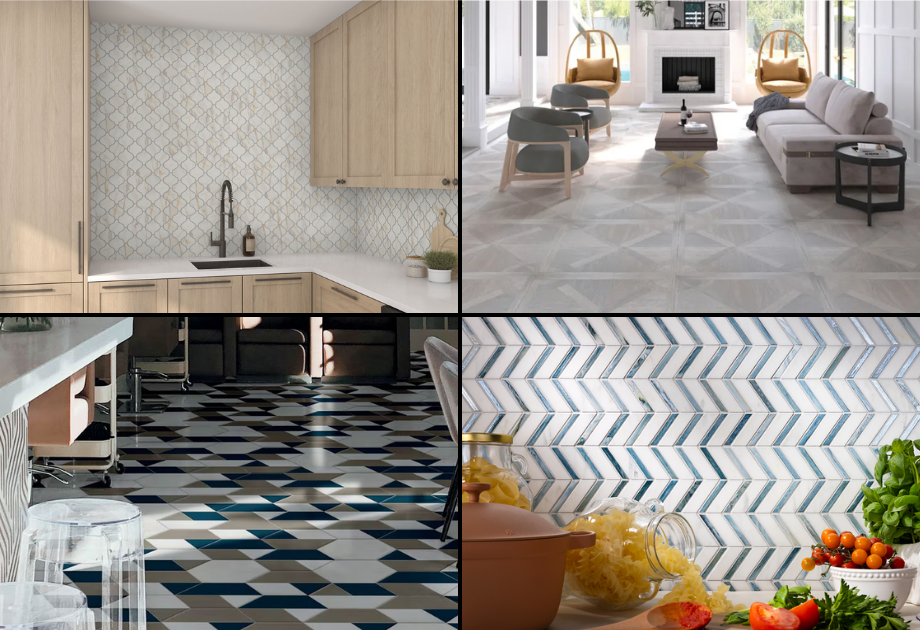
Geometric Layouts: Where Shape and Arrangement Do the Work
Geometric tile is about a celebration of form. Manufacturers are now shaping tiles into arabesques, rhombuses, hexagons, and chevrons, producing pieces whose silhouette is the whole design before a single one is laid. The shape itself is the statement.
What that looks like in a finished room is something no grid of squares can do. An arabesque lantern tile behind a kitchen sink gives the whole backsplash a soft, Moorish rhythm that a square tile would flatten completely. A rhombus mosaic in navy, ochre, and cream turns an office floor into something closer to a painting. Even a single chevron, cut sharp and laid along a backsplash, sends a clean diagonal motion across the wall that rectangles can't produce. These are tiles designed to be seen as shapes first.
Arrangement is the other half of the story. The layout itself becomes the design, and a handful of classic patterns are having a real moment in 2026:
- Herringbone gives a floor directional movement, perfect for kitchens and entryways that want energy underfoot.
- Chevron tightens that same energy with sharper angles and reads a little more refined.
- Hexagons step outside the grid entirely, creating organic motion that softens bathrooms and mudrooms without turning floral.
- Versailles interlocks squares and rectangles of different sizes into a single repeating module that feels palatial without feeling fussy.
- Large-format tiles reduce seams for an open, unified read that lets a single surface carry the whole room.
- Small-format tiles reward a closer look, with tight patterns and fine details that show up best in smaller spaces like powder rooms and shower niches.
Pictured: Hamilton Parker Vesuvio, American Olean Mythique Marble, Louisville Tile Cask (shown in the Versailles pattern), and Daltile Bee Hive Medley. Each product page lists full specs and approved applications.
Warm Earth Tones: Terracotta, Clay, and the Colors Taking Over
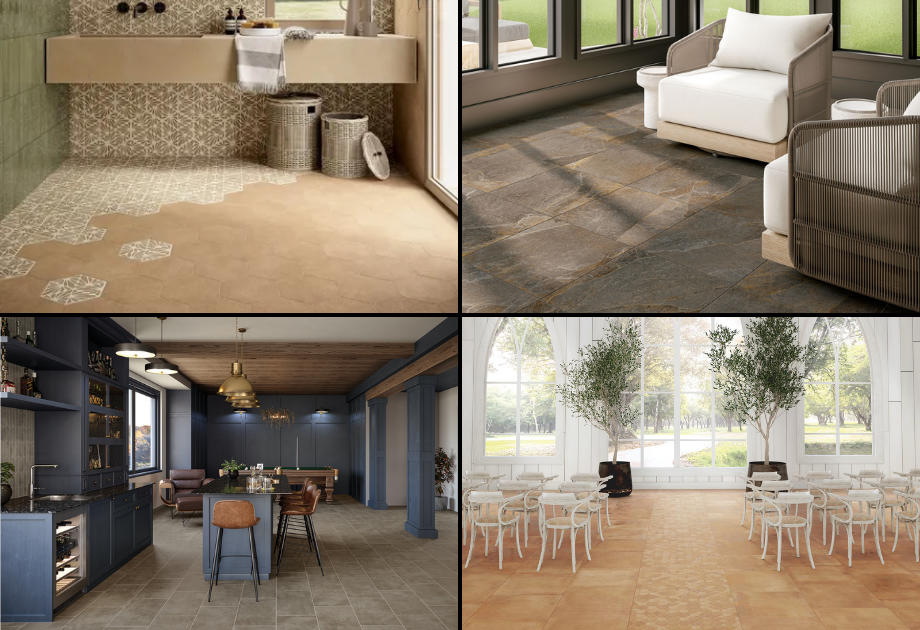
Warm earth tones are the palette shift defining 2026 tile. Terracotta, sand, ochre, sage, clay, and muted blue-green have replaced the cool grays and stark whites that dominated the last decade, and they're showing up across kitchens, bathrooms, and living spaces as full-floor choices rather than accent picks. Italian manufacturers at Cersaie 2025, the world's largest ceramic tile exhibition, called the direction "New Nostalgia."
What these colors do in a finished room is settle it. A bathroom floor in warm terracotta reads like a place to slow down in, not a place to rush through, and a sage kitchen floor carries the calm of a room you'd actually want to cook in all afternoon. The matte finishes most of these tiles arrive in do the heaviest lifting. They absorb light instead of reflecting it, which gives the whole room a quality closer to soft morning light than to the hard overhead glare of the last decade's glossy surfaces.
The other reason these tones are winning is how well they pair with everything else a home already has. Wood vanities, brushed metal fixtures, natural textiles, and textured stone all register more richly against a warm-toned floor than they ever did against a cool gray one. The choice between glossy, matte, and textured finishes matters as much as color itself, and in this palette, matte is almost always the right answer.
Pictured: Daltile Rekindle, American Olean Constant, Hamilton Parker Atlas Concorde Cove, and Louisville Tile Terracreta. Each product page lists full specs and approved applications.
Textured and Dimensional Tile: Depth You Can See and Feel
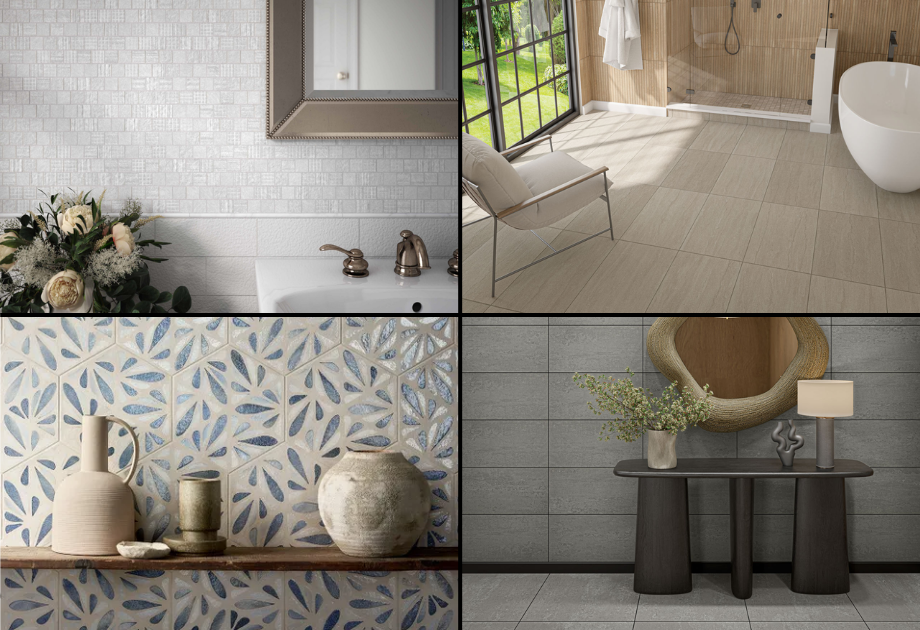
Textured tile is tile with a sculpted face, worked with ridges, relief, or hand-finished roughness so the surface itself becomes the design. Manufacturers are pressing, carving, and hand-troweling what used to be flat ceramic into something closer to architectural detail. The result is a tile that reads differently from every angle, changes with the light in a room, and almost always gets touched.
What textured tile does in a finished room is invite a second look. A fluted shower wall breaks the water into soft vertical lines as it runs down, turning a daily ritual into something closer to a spa moment. A relief accent wall behind a vanity holds shadow across its whole surface, giving the bathroom a sculpted presence in place of paint. On a kitchen or entry floor, a textured matte finish brings the kind of earthy, lived-in presence a smooth floor never will, adding visual depth the moment you walk in and real personality the longer you stay.
Light is what makes any of this work. Recessed or directional lighting rakes across the texture and deepens the relief, while flat overhead light flattens the effect entirely. The case for tactile surfaces throughout a home applies to floors as well as walls.
Pictured: Louisville Tile Taviano, Hamilton Parker Shift, American Olean Theoretical Evolved, and Daltile Haddonstone. Each product page lists full specs and approved applications.
See What Tile Can Do at A Step Above Flooring
Tile is one of the few materials in a home that earns its place twice: once for how it holds up and again for the personality it brings to a room. Any of the six trends in this blog can carry a space beautifully, but the right tile for your home depends on the light it'll live in, the materials it'll share a room with, and the way you actually want to feel when you walk in.
That's the conversation our team enjoys most. Stop by the showroom to see these collections in person, feel the textures under your hand, and talk through what the perfect floor looks like for the way you live. Start the conversation with our team.