
What Carpet Padding Does for Your Floor and How to Choose the Right One
What Carpet Padding Does for Your Floor and How to Choose the Right One
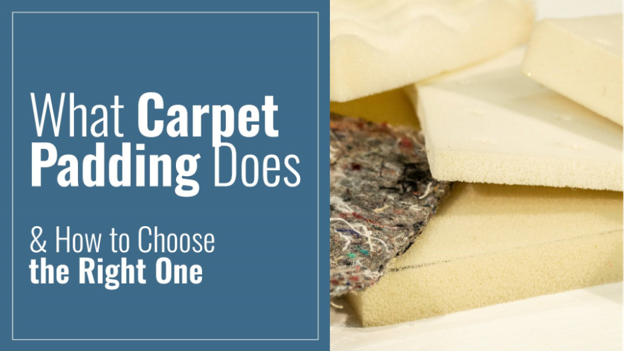
When you shop for carpet, you probably have a few things in mind that you want to consider. You compare colors and textures until you find one you like at a price you can live with. You might not even think to consider the pad that goes underneath.
But the pad has more to do with how your new carpet will perform than the carpet itself does. It determines how long the carpet holds its look, it shapes how the floor feels underfoot, and it supports the temperature and volume of the room it's in.
This blog will discuss more about what the carpet pad does for your floor and how to choose the right one.
.png)
What Carpet Padding Does for Your Floor
Carpet padding is a soft, durable material laid under the carpet. It's also called carpet cushion or carpet underlayment. Without a pad, the carpet is installed straight onto the subfloor, a hard sheet of plywood or concrete. So every footstep, chair leg, and rolling load presses the fibers down against it, dozens to thousands of times a day.
But when you have a pad between your carpet and subfloor, the pressure of what's on the carpet gets spread more evenly. In fact, a carpet that has a pad endures only about half the impact of a carpet without one. By cutting the force in half, the pad actually prolongs the life of your carpet.
.png)
How Padding Keeps Your Carpet From Wearing Out
Most carpet gets replaced for how it looks, not because the fibers have worn through. The pile lies down, mats in the traffic paths, and loses the height that made it look full. Pile height, more than the fiber itself, is what you are paying to keep.
And a pad is what keeps it. When you step, the fibers compress, and the pad lets them spring back instead of staying crushed against the subfloor. Over years of traffic, the rebound keeps a carpet full instead of flat.
The effect shows up in testing. A textile lab rolled a 150-pound chair over carpet 20,000 times. The carpet with no pad lost 19.3% of its pile height, while the same carpet over a pad lost only 5 to 10%.
How Padding Makes a Room Comfortable, Warm, and Quiet
A carpeted room is more comfortable to be in than a bare-floor one, and the pad does much of the work. The softness you feel underfoot comes mostly from the pad, not the carpet, because the pad is what cushions each step. A softer pad suits a bedroom you want your feet to sink into, and a firmer one suits a room you walk across all day.
The pad also slows heat from leaving through the floor. To speak scientifically about it, carpet cushion adds an R-value of roughly 0.75 to 2.09 depending on the material. A higher R-value keeps more heat in the room. So, carpet padding insulates the floor the way a rug over cold tile does.
It quiets the room the same way. Bare concrete absorbs little of the noise that hits it, while the same floor with carpet and cushion absorbs far more. Footsteps, voices, and television all end up sounding softer in a room built over a pad.
How Padding Protects Your Carpet’s Warranty
Most carpet warranties come with a condition attached: the pad underneath has to meet the manufacturer’s requirements. Those requirements usually set a maximum thickness and a minimum density, two measurements we’ll break down below. A pad outside those limits can void the warranty, and the wear coverage goes with it.
The most common way to fall outside the limits is choosing a pad that’s too thick or too soft for the carpet. Checking the requirements before you buy keeps that coverage in place for the life of the floor.
How to Choose the Right Carpet Padding
The best carpet padding is the one matched to the carpet going over it and the room it goes into. A pad that works under one carpet can be wrong under another, because different carpets need different support. Carpet makers spell out what each carpet needs, and the Carpet and Rug Institute publishes cushion guidelines that back them up.
Understanding Density and Thickness
Every pad label lists two numbers that measure different things:
- Carpet pad thickness is how tall the pad is, in inches.
- Carpet pad density is how much it weighs per cubic foot, in pounds.
It’s actually density, not thickness, that provides the support your carpet needs.
The trouble in deciding which is right for your carpet often comes because the thick, soft pad feels best in the store. But once it's in the room, the softness lets the carpet flex too far under every step, which can work the carpet loose and pull it into ripples. So, the guideline typically recommends lower thickness and higher density. Together, they keep the carpet firm enough to stay flat and soft enough to feel good.
Padding Types and Where Each One Works
Carpet padding comes in a few materials: foam, denser bonded foam, rubber, and fiber. Which one depends on how hard the room works the floor.
A bedroom works the floor the least, so it takes the softest pad, around 7/16 inch at 6 pounds of density.
A family room works harder. Couches press on it, chairs roll across it, and the same paths get walked all day. A firmer pad near 8 pounds of density holds up under the weight and traffic where a bedroom pad would crush.
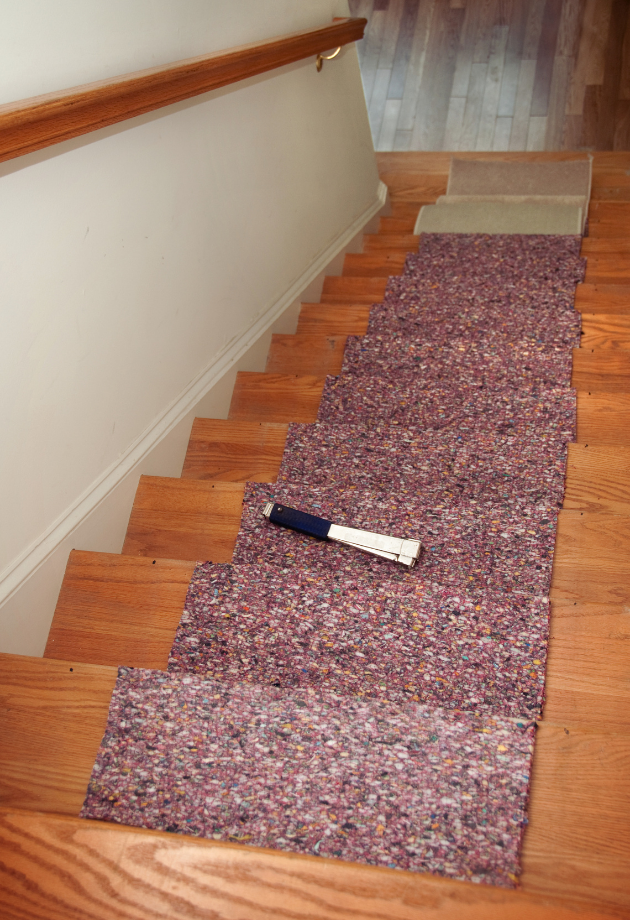
Stairs work the floor hardest, and there you choose by density first, not thickness. A stair pad should be firm and thin, at 3/8 inch and 8 pounds or more. Our team doesn’t go any thinner than that on stairs. Carpet bends hard over the edge of each step, and a firm, thin pad keeps it from breaking down there. Keep in mind that most manufacturers don’t extend their warranties to carpet on stairs, though a few styles are the exception. We can point you to the styles that carry coverage
Choose the Right Carpet and Padding with A Step Above Flooring
The pad you might not have thought about in the showroom is what ultimately determines how the carpet you chose performs. Everything you weighed at the surface – the color, the texture, and the price, rides on the layer underneath it.
A good pad is a small part of the flooring price, and it protects the far more expensive carpet on top. Spending a little more there protects the rest.
You don't have to weigh the specifications alone. The flooring experts at our Cincinnati showroom can walk you through everything you need to consider. Come on in and let's talk about your flooring project from the pad up.